A World of Law, Borders,
and Cartoons
ABOUT ME
I am a Postdoctoral Researcher in the REBOUND project (Reconceptualizing Boundaries Together Towards Resilient and Just Arctic Future(s)) at the University of Helsinki, Faculty of Law. I am also affiliated with the Refugee Law Initiative of the University of London, Helsinki Institute of Sustainability Science (HELSUS), and the Erik Castrén Institute of International Law and Human Rights at the University of Helsinki.
I hold a Doctor of Laws (with distinction) in Refugee Law and Border and Migration Studies from the University of Helsinki (2025). My current research focuses on migration governance and EU asylum and migration law, examining these through the lenses of critical border and migration studies, human rights, and justice theories. I use diverse qualitative methods, involving the systematic analysis of legal texts, visual images, and empirical data gathered through interviews.
I obtained a Master of Social Sciences (MSocSc) degree in International Relations and Political Science from Tampere University (Finland) in 2019, and a Bachelor of Laws (LLB) degree and a minor degree in International Relations from Koç University (Istanbul, Turkey) in 2017. I held various research-related positions, including as a visiting doctoral researcher at the Nijmegen Centre for Border Research at Radboud University (2023), as a project researcher at the University of Eastern Finland (2021-2022), and as a research assistant at Migration Research Center (MiReKoc) at Koç University (2017) and the Institute of International Relations Prague (2016). I taught courses on migration and border studies, international refugee law, and the intersections of human rights and visual arts at Tampere University.
My articles appeared in several internationally renowned peer-reviewed journals, including the International Journal of Refugee Law, Geopolitics, Ethnicities, Journal of Immigrant and Refugee Studies, and Forced Migration Review. My master’s thesis, entitled ‘Rethinking Rightlessness: The Right to Have Rights and the EU-Turkey Statement’, was published as a book in 2023 (On İki Levha). I am also enthusiastic as a political cartoonist about reflecting on contemporary phenomena, such as human rights issues, inequalities, and injustices, in my editorial cartoons.
CURRENT PROJECT
As a Postdoctoral Researcher in the REBOUND project, I examine the ‘justness’ of the EU green transition for workers with migrant and refugee backgrounds, with a case study on the Finnish Arctic. This work investigates whether the needs, perspectives, and rights of these workers are heard in this transition, uncovering the potential inadequacies within current governance structures and the ways to ensure an inclusive and equitable transition for all stakeholders. This research utilizes multiperspectival socio-legal methodology, juxtaposing top-down regulatory frameworks with bottom-up perspectives of the affected individuals. Within this project, I employ empirical socio-legal research methods, including semi-structured interviews with representatives of companies and NGOs, and refugees and migrants in green sectors, to understand their lived experiences in the context of the green transition.
PREVIOUS PROJECT
My doctoral research project investigated the interplay between the externalization and internalization of migration management and the political agency of refugees in irregular circumstances (including asylum seekers) in border zones. This empirical socio-legal project drew on a transdisciplinary approach by combining law and social sciences with visual art. I conceptualized migration management as a process of border-making and examine its mutually constitutive interplay with the struggles of refugees to reach, settle, and be included in the destination states. Within this project, I conducted three empirical case studies on the European Union’s Greek-Turkish external border, focusing on the implications of migration management for refugee ‘access’. I employed a range of qualitative methods, mainly analysis of legal texts and policy documents, visual analysis of refugee-produced paintings, and multimodal analysis of refugee-produced social media content. I developed a grounded analytical framework with perspectives from critical border studies and contemporary political theorists.

OUT NOW!
My doctoral thesis ‘Undoing the Borders of ‘Access’ : A Socio-Legal Inquiry into Migration Management and Refugee Struggles at the European Union’s External Borders’ is now available in electronic form at the University of Helsinki Open Repository, Helda.
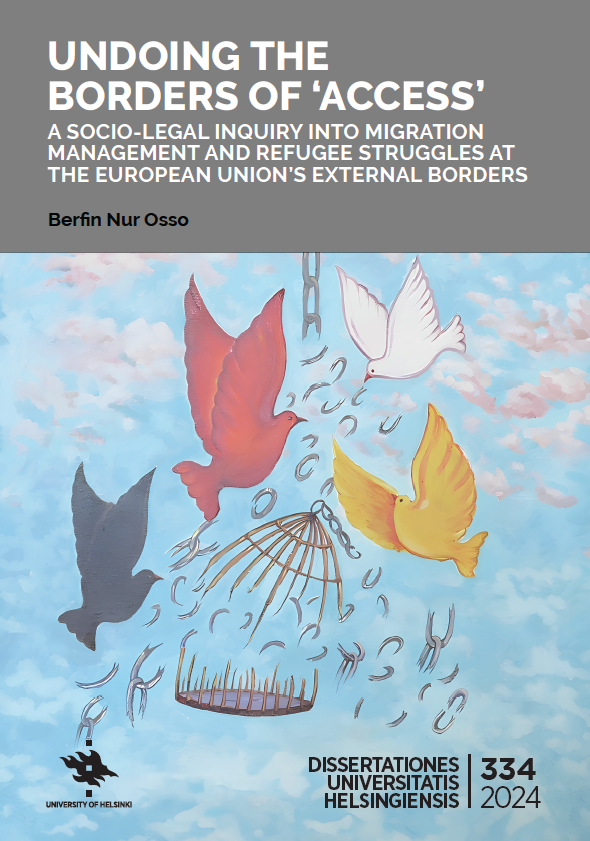
This thesis investigates the interplay between the externalization and internalization of migration management and the political agency of refugees. It consists of five peer-reviewed publications and an introduction, reflecting the findings from three case studies conducted between 2021 and 2023 on the five Eastern Aegean islands of Greece. The thesis responds to the questions of what kind of borders are produced through migration management measures in reaction to refugee mobility, how and where they are produced, how this affects refugee ‘access’, and what this means for refugees who constantly encounter these measures. The main objective is to develop an analytical framework that is theoretically informed, contextually detailed, and grounded in the case studies. The framework provides an understanding of how states manage refugee ‘access’—a selective inclusion process to the state territory, protection (asylum, including procedures, and other rights), and society—within and outside their territories, and how refugees get access.
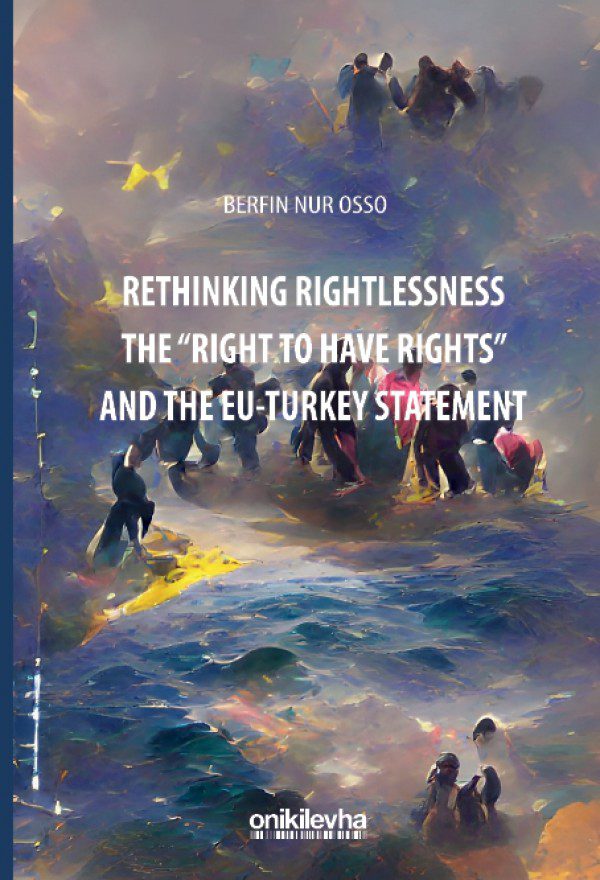
My master’s thesis ‘Rethinking Rightlessness: The “Right to Have Rights” and the EU-Turkey Statement’ is now published as a book by On İki Levha . You can order the book from this link (within Türkiye) or this link (outside Türkiye, within Europe).
Following the summer of migration in 2015, the EU and Turkey came to a deal on 18 March 2016, which is officially known as the EU-Turkey Statement. The implementation of the Statement raised concerns especially over the human rights violations it entails vis-à-vis the migrants, who are returned from the Greek islands to Turkey or who are expelled from the EU territory at the very Greek-Turkish border. Rather than “merely” depriving these people of certain set of rights enshrined in international and regional human rights instruments, the EU-Turkey Statement deprives them of a more fundamental “right to have rights” – which also puts other rights in jeopardy.
With the increasing uses of the EU’s externalization measures and informal readmission arrangements, such as the EU-Turkey Statement of 18 March 2016, it becomes ever-increasingly important to understand the implications of these measures for refugees and their ‘right to have rights’.
From the back cover:
’While the case studies which this work is based upon are predominantly taken from mid-2015 until February 2019, it continues to help us see and understand the current situation that rightless refugees are facing at the doorsteps of the EU, within Turkey, or elsewhere in the world. This work, therefore, provides illuminating insights for people who would like to learn further about the contemporary struggles of refugees who are directly or indirectly affected by the externalization measures of the EU.’
 PORTFOLI(O)SSO